icon AnyCamVLA: Zero-Shot Camera Adaptation for Viewpoint Robust Vision-Language-Action Models

IROS 2026
Seoul National University1 Massachusetts Institute of Technology2
TL;DR

Fine-tuned VLAs break when the camera moves. AnyCamVLA keeps the policy frozen and instead adapts the input view in real time—a feed-forward novel view synthesis model re-renders the live camera into the policy's training viewpoint—making any RGB-based VLA viewpoint-robust with no extra demonstrations, policy fine-tuning, or architectural changes.

Motivation

To deploy a Vision-Language-Action model (VLA) in your own setup, you first fine-tune a large pre-trained model on a handful of demonstrations collected in that specific environment—the same camera placement, the same robot embodiment, the same workspace. A small number of demo trajectories is enough to get the robot working in the lab.

The problem is that these fine-tuned VLAs are remarkably fragile to perturbations. Because they operate directly on 2D RGB observations without explicit spatial supervision, they overfit to the exact configuration seen during training. Recent robustness studies such as LIBERO-Plus quantify this: success rates that exceed 90% on the original setup collapse dramatically the moment any factor is perturbed.

VLAs collapse under perturbations — and camera changes are by far the worst

Model Original Camera Robot Language Light Background Noise Layout
OpenVLA76.51.14.126.84.425.319.331.6
OpenVLA-OFT97.159.737.281.585.892.476.777.1
OpenVLA-OFTw95.316.843.773.268.292.551.472.3
OpenVLA-OFTm97.657.930.683.691.683.676.373.2
π094.215.86.661.079.678.579.470.4
π0-fast85.566.424.863.373.067.775.870.3
Nora87.94.041.167.031.050.517.663.9
WorldVLA79.10.330.244.229.414.512.239.4
UniVLA95.24.350.371.859.180.025.334.3
RIPT-VLA97.558.336.780.187.990.473.876.5

Task success rate (%) of recent VLAs under each perturbation factor, reproduced from LIBERO-Plus (Fei et al., 2025), Table 1. Across nearly every model, the camera column shows the largest degradation—dropping to single digits for several policies—making camera viewpoint the single most critical failure mode.

We tackle exactly this camera sensitivity of VLAs. Even minor, unavoidable shifts in everyday unstructured environments break the policy—for example, we observe that a mere 3 cm shift in the wrist camera can halve the success rate—yet the end-to-end nature of VLAs normally forces you to recollect demonstrations and re-fine-tune the entire model after every change.

Our Idea: Adapt the View, Not the Policy

Our approach is simple yet effective: keep the policy frozen and only adapt the input view in real time. Instead of retraining the VLA to tolerate new camera placements, we virtually move the camera back to the canonical view—the viewpoint the policy was trained on—and render the scene from there. The frozen policy then sees exactly the kind of image it expects, regardless of where the real camera actually is.

To do this, we use a feed-forward novel view synthesis (FFNVS) modelLVSM in our paper—as a plug-and-play camera-adaptation module. As shown in the video above, at every control step it takes the live test-time observations and synthesizes the corresponding training-view image—the virtual view—in a single forward pass, which is then simply fed to any RGB-based VLA with no policy fine-tuning and no architectural modification. Because the module handles only visual input and runs at ~30 Hz—faster than the ~10 Hz VLA control loop—it adds negligible overhead and naturally handles changes in both extrinsics (pose) and intrinsics (focal length), working across diverse setups and even freely moving handheld cameras such as an iPhone, ZED, and RealSense.

Results

TAKEAWAY 1

Feed-forward novel view synthesis dramatically improves viewpoint robustness. By adapting observations back to the training view, our method keeps the policy near its original success rate even under large camera shifts (up to 15 cm translation and 60° rotation), where the base policies collapse.

Table I — Success rate (%) on unseen agent camera viewpoints (LIBERO-Long)

Method Original SmallMediumLargeAverage
OpenVLA-OFT94.579.68.810.432.9
π0.592.485.646.814.649.0
π0.5* (data aug.)79.676.475.071.674.3
GeoAwareVLA93.086.083.679.082.9
Ours-OV94.589.679.467.678.9
Ours-π92.491.088.686.288.6

Results on the LIBERO-Long suite under agent camera perturbation. The Original column is the unperturbed reference. Base policies collapse as the perturbation level grows from Small → Medium → Large (π0.5 falls from 92.4% original to 14.6% under large shifts), while our adaptation keeps the frozen policy near its original performance— Ours-π reaches 88.6% average, close to its 92.4% original. Bold marks the best result under perturbation.
The viewpoint-augmented dataset (π0.5*) is randomly sampled and does not contain the original view, so fine-tuning lowers its original-view performance.

Table II — Success rate (%) on unseen wrist camera viewpoints (LIBERO-Long)

Method Original SmallMediumLargeAverage
π0.592.440.839.85.228.6
π0.5* (data aug.)79.684.084.081.283.1
GeoAwareVLA93.01.65.09.05.2
Ours-π92.491.889.684.488.6

Under the harder wrist camera perturbation, the representation-centric GeoAwareVLA collapses to below 10% because its 3D features are anchored to the wrist frame, while our method—synthesizing photorealistic canonical views—remains robust at 88.6% average. The Original column is the unperturbed reference. π0.5*'s augmented dataset does not contain the original view.

TAKEAWAY 2

Zero-shot view adaptation beats fine-tuning with data augmentation. The common alternative—augmenting demonstrations with novel viewpoints and fine-tuning the policy—is costly and unreliable: it requires demonstrations from many tasks and suffers catastrophic forgetting on the original view. Our frozen-policy approach avoids both, with no extra demonstrations or training.

Original View 40 60 80 100 0 1K 5K 10K Fine-tuning steps Task Success Rate (%)
Unseen Views 40 60 80 100 0 1K 5K 10K Fine-tuning steps Task Success Rate (%)
π0.5* (1 task) π0.5* (5 tasks) π0.5* (10 tasks) Ours-π (zero-shot)

Fine-tuning π0.5 on viewpoint-augmented data (π0.5*) over 1 / 5 / 10 tasks. (Left) Success on the original view steadily declines as training progresses—a sign of catastrophic forgetting. (Right) Even with all 10 tasks, success on unseen views plateaus well below our zero-shot method (Ours-π, dashed), which requires no fine-tuning at all.

Real-World Experiments

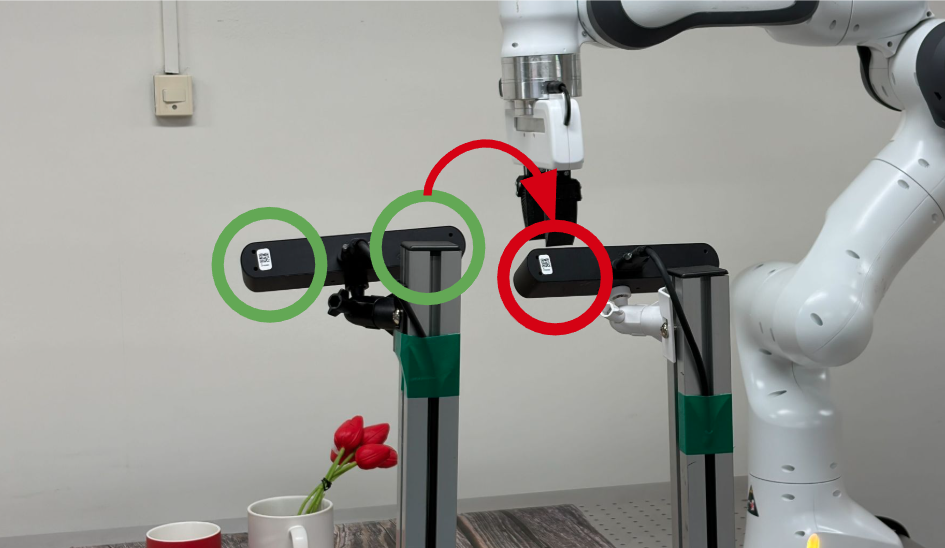
Real-world camera setup

Camera setup. We use a ZED stereo camera providing two input views that serve as the training views (green circles). At test time, we replace the right-side view with the view from another camera placed at a different position (red circle), and our feed-forward novel view synthesis renders it back to the original right training view.

Input View 1
left (unchanged)
Input View 2
right → another camera
Synthesized View
adapted to training view
Ground Truth
original right view

“Pick the lemon and place it in the bowl”

Input View 1
left (unchanged)
Input View 2
right → another camera
Synthesized View
adapted to training view
Ground Truth
original right view

“Put the tennis ball in the box and close the box”

Input View 1
left (unchanged)
Input View 2
right → another camera
Synthesized View
adapted to training view
Ground Truth
original right view

“Pick the red tulip and place it in the white mug”

Input View 1
left (unchanged)
Input View 2
right → another camera
Synthesized View
adapted to training view
Ground Truth
original right view

“Pick the stainless mug and place it on the plate upright”

Freely-Moving Handheld Cameras

Using the same two-view setup as above, we now replace the right-side test view with a freely-moving handheld camera that a person waves around while the policy runs. Each camera's pose is tracked with ArUco markers, and our feed-forward novel view synthesis renders the canonical training view in real time — so the frozen policy keeps working despite the constantly changing camera pose. We test three very different cameras — an iPhone 17 Pro, an Intel RealSense D435, and a ZED 2 — each with its own intrinsics, showing that our adaptation also generalizes across camera models. Each clip shows, left to right, the raw camera input, the synthesized view fed to the policy, and the resulting policy execution.

Handheld view
Synthesized view
Policy execution

iPhone 17 Pro — “Pick the red tulip and place it in the white mug”

Handheld view
Synthesized view
Policy execution

Intel RealSense D435 — “Pick the red tulip and place it in the white mug”

Handheld view
Synthesized view
Policy execution

ZED 2 — “Put the tennis ball in the box and close the box”

References

  • S. Fei et al., “LIBERO-Plus: In-depth Robustness Analysis of Vision-Language-Action Models,” arXiv preprint, 2025. arXiv:2510.13626
  • H. Jin et al., “LVSM: A Large View Synthesis Model with Minimal 3D Inductive Bias,” ICLR, 2025. arXiv:2410.17242
  • M. J. Kim, C. Finn, and P. Liang, “Fine-Tuning Vision-Language-Action Models: Optimizing Speed and Success (OpenVLA-OFT),” arXiv preprint, 2025. arXiv:2502.19645
  • Physical Intelligence et al., “π0.5: a Vision-Language-Action Model with Open-World Generalization,” arXiv preprint, 2025. arXiv:2504.16054
  • A. Abouzeid et al., “GeoAware-VLA: Implicit Geometry Aware Vision-Language-Action Model,” arXiv preprint, 2025. arXiv:2509.14117

BibTeX

@article{heo2026anycamvla, title = {AnyCamVLA: Zero-Shot Camera Adaptation for Viewpoint Robust Vision-Language-Action Models}, author = {Heo, Hyeongjun and Woo, Seungyeon and Kim, Sang Min and Kim, Junho and Lee, Junho and Lee, Yonghyeon and Kim, Young Min}, journal = {arXiv preprint arXiv:2603.05868}, year = {2026} }